With the rapid rise of AI innovation, one question is dominating the headlines: How will this affect the future of work?
This concern has sparked anxiety among students: Will AI take my job before I even graduate?
The job market is splitting into two distinct groups: those at risk of being replaced by AI, and those using it as a tool to increase their productivity. According to the World Economic Forum, while 85 million jobs may be displaced by automation, 97 million new roles are expected to emerge, roles that require a combination of human creativity and digital skills.
The WEF further warns that nearly 39% of existing skills will be outdated by 2030. This reality has shifted what the younger generation looks for in a university. Students are increasingly seeking universities that provide practical skills for the digital age alongside traditional degrees.
While many universities are in the process of defining their AI strategies, Xi’an Jiaotong-Liverpool University (XJTLU) in China has established the infrastructure to prepare students for this shift.
Many students graduate with portfolios demonstrating how they apply AI within their disciplines.
Here is how XJTLU makes that happen:
Real Student Projects
International students prioritize graduating with practical, applicable skills. XJTLU addresses this by integrating deployment experience into the curriculum, ensuring students are ready to solve real-world problems.
AI Medical Training Tool
Medical training faces a global bottleneck: students need extensive clinical practice, but resources are often unevenly distributed and opportunities for real patient interaction can be scarce. To address this fragmentation, Master’s students Yuhan Liu and Zhe Xu from the XJTLU Academy of Future Education developed “Hellodoc Chuyi.”
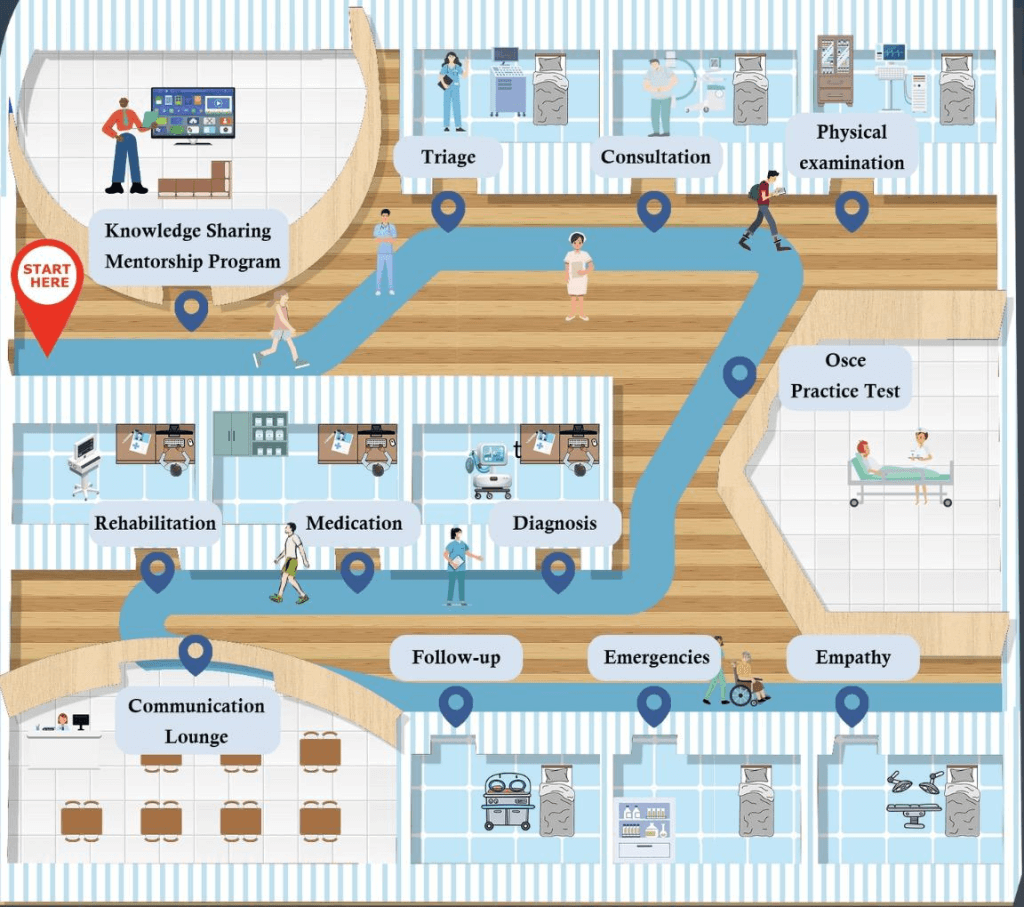
Integrating theory with practice, the software uses artificial intelligence and multimodal image recognition to generate simulated consultation exercises. This allows aspiring doctors to navigate complex medical scenarios in a risk-free virtual environment, effectively bridging the gap between textbook learning and clinical application.
The project’s impact was recognized globally when it won the Bronze Award at the Seventh Global Competition on Design for Future Education, a UNESCO-backed event. Developed under intense pressure during a 48-hour hackathon, the tool highlights XJTLU’s commitment to using digital innovation to promote educational equity. The team is currently refining the software for a planned public launch.
The Data Scarcity Solution: Crucial-Diff
While some students build robots or buildings, others are solving the fundamental bottlenecks of AI itself. Siyue Yao, a PhD candidate at the School of Advanced Technology, led a team to address “data scarcity,” a major issue where deep-learning models fail because they lack enough examples of rare problems.
Instead of relying on the traditional method of just collecting more data, Yao’s team developed Crucial-Diff. This AI framework acts like a coach, identifying the model’s “blind spots” and generating specific, synthetic data to fix those weaknesses.
The results have been transformative. In industrial quality inspections, the framework boosted defect detection accuracy to 83.63%, outperforming traditional methods. It also successfully generated privacy-safe medical images to improve polyp detection. Published in the prestigious IEEE Transactions on Image Processing, Yao’s work proves that XJTLU students are leading the shift from “Big Data” to “Smart Data”
AI for Every Major
Students in non-technical fields, like Marketing, English, or Architecture, often question the relevance of AI training. At XJTLU, graduates learn to use AI to perform their specific jobs more effectively.
Under the Education + AI Strategic Framework (2025-2028), XJTLU is implementing a fully integrated AI curriculum across all academic levels.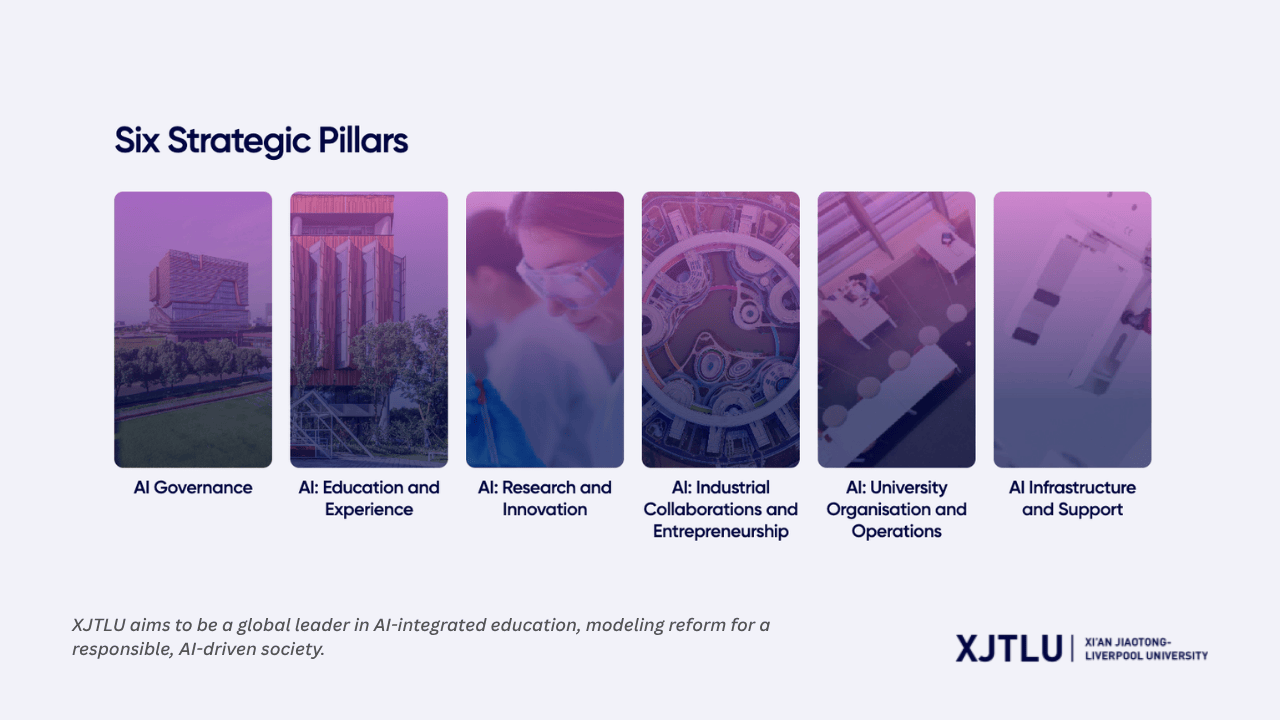
Discipline-Specific Breakdown
For Architecture & Design Students:
Students use AI to generate building iterations in minutes, optimizing for sustainability and cost. The framework encourages broadening topics beyond current program structures to include these emerging tools.
For Business & Marketing Students:
Through the College of Industry-Entrepreneurs (CIE), learning integrates with real industry problems. Students use AI to analyze market trends and consumer sentiment.
For Humanities & Creative Students:
Students master tools like XIPU AI (the university’s custom platform) to handle translation, content scaling, and research efficiency, allowing them to focus on creative direction.
For Science Students:
Using the university’s Supercomputing Platform (targeting 45.3 PFLOPS by 2027), students run simulations that accelerate research from months to days.
XIPU AI
XJTLU’s central platform, XIPU AI, integrates over 20 leading large language models and multimodal tools into a single dashboard. Supported by the XJTLU Learning Mall, it powers your entire academic workflow:
- The Research Accelerator: The platform’s Automated Content Tools allow you to summarize dense academic materials, extract key data, and rewrite content to improve your research efficiency.
- The Creative Partner: The Intelligent Image Recognition and Generation tools help you process images and generate visuals, making your coursework and presentations more interactive.
- Be the Architect: With the XIPU AI Agent, you can be a creator. Using low-code/no-code tools, you can build your own personalized “learning companion” or deploy intelligent service bots to manage your daily tasks.
Industrial Partnerships: The Baidu Advantage & X-Eco Mall
XJTLU has established full operational joint ventures to ensure industry relevance.
The XJTLU-Baidu AI Alliance
The XJTLU-Baidu Artificial Intelligence Innovation Alliance is a joint venture between the university, Baidu (China’s tech giant), and the Suzhou Industrial Park government.
Through this alliance, students gain access to the Baidu AI Cloud Qianfan Platform and PaddlePaddle, Baidu’s deep learning framework used by over 5 million developers globally. Through the Innovation Centre, students work on industrial-grade projects, learning on the infrastructure used by China’s biggest companies to build real AI applications, moving beyond theoretical coursework.
X-Eco Mall: The Startup Launchpad
X-Eco Mall is a physical and digital ecosystem designed to turn student ideas into fundable businesses.
The ecosystem proactively addresses digitalization by providing a dedicated space for students, faculty, and industry professionals to collaborate. It facilitates access to funding and mentorship, helping students translate research into market-ready solutions. Through Baidu’s enterprise tools and X-Eco Mall’s funding connections, students build their careers in the ecosystem where new technology is actively being developed.
Student Life at XJTLU
XJTLU hosts students from over 90 countries. You might work on a group project with peers from South Korea, Russia, and Indonesia. This cross-cultural fluency is exactly what multinational employers look for.
Plus, Shanghai is just 25 minutes away by high-speed train, giving you access to China’s financial capital whenever you need it.
You can explore campus tour here:
Looking Ahead
Most universities are currently determining how to integrate AI into their curriculum. XJTLU has already built the Education + AI Strategic Framework and is executing it now.
XJTLU represents an institution that has proactively prepared for the AI era. The curriculum prioritizes deployment alongside theory.
The Artificial Intelligence era is here, and XJTLU ensures students are ready to lead it.
Explore XJTLU Undergraduate Programmes to see how AI is being integrated into your specific major.
Continue reading: