
You’re weighing an MBA in Asia. China and Malaysia keep coming up. Both have English-taught programs. Both cost less than Western schools. And both give you access to growing economies. But they’re different in ways that matter.
Here’s what you need to know about tuition, post-graduation work options, career outcomes, and what daily life actually looks like in each country.
Tuition Fees
MBA programs in China range from RMB 100,000 to RMB 488,000 ($14,000 to $68,000) for the full program. Top programs like CEIBS charge RMB 488,000 ($68,000) for their 16-month MBA. Peking University Guanghua charges around RMB 188,000 ($26,500) for their 22-month program. Zhejiang University’s 2.5-year International MBA costs RMB 336,000 ($46,500).
Malaysia’s MBA programs cost between RM 25,000 to RM 120,000 ($5,800 to $28,000). University of Malaya charges RM 32,000 to RM 60,000 ($7,400 to $14,000) for international students. Taylor’s University costs around RM 45,000 to RM 70,000 ($10,500 to $16,300). Asia School of Business, in collaboration with MIT, is the outlier at the higher end.
Monthly living costs differ too. In China, expect to spend $300 to $1,000 per month for a one-bedroom apartment off campus, or $150 to $400 for student housing. Malaysia runs slightly lower at RM 1,200 to RM 2,500 ($280 to $580) per month for total living expenses.
Malaysia wins on upfront cost. You’ll spend roughly half what you’d pay in China for a comparable program.
Top MBA in China
China has many top-ranking MBA schools but these are the best ones that dominate world-ranking charts for many years now.
 |
China Europe International Business School (CEIBS)The MBA program at CEIBS is a full-time program with a duration of 12 or 18 months. If you want a quicker option, choose the 12 month program. The medium of instruction is English. Watch a video of CEIBS here. |
 |
International MBA at Renmin Business SchoolThe International MBA at Renmin is a two-year program taught in English. Renmin was one of the first business schools to start MBA education in China, founded in 1950. The program holds AACSB and EQUIS accreditation. |
 |
Peking University BiMBABiMBA offers several MBA programs for international students. BiMBA has been ranked #1 in China by Fortune and Forbes for years. It is known as the “Business School within a think-tank.” |
 |
Global MBA Program at Tsinghua University The MBA program offered at Tsinghua University is a joint program by Tsinghua and MIT. This program enables you to gain access to Tsinghua and MIT’s joint resources. You will also be taught by the faculty of both schools, interact with students and connect with two alumni networks. |
 |
International MBA at Fudan UniversityIn collaboration with MIT Sloan School of Management, Fudan also offers the Fudan-MIT International MBA (iMBA). It is taught in English. Fudan offers one of the most extensive business exposures and intensive advice and support to students. |
You can explore more MBA programs in China here.
Top MBA in Malaysia
Malaysia offers quality MBA programs at affordable costs. These programs combine international accreditations with Southeast Asian market access.
 |
MBA at Taylor’s UniversityTaylor’s MBA is ranked #1 in Malaysia according to the 2026 QS Global MBA Rankings. The program ranks 131-140 globally and 20th in Asia. Taylor’s achieved 100% graduate employment rate. The program is designed for experienced professionals looking to climb the corporate ladder. |
 |
MBA at Asia School of Business (ASB) in collaboration with MIT SloanASB was established in partnership with MIT Sloan School of Management, one of the world’s most prestigious business schools. This brings MIT-level education to Southeast Asia’s business environment. The ASB MBA is known for its Action Learning curriculum. Students spend significant time working on real-world projects with host companies across Southeast Asia. You can learn more about ASB here. |
 |
MBA at Universiti MalayaUM consistently ranks as one of the top universities globally. The MBA program is accredited by AACSB and AMBA, ensuring high educational standards. The program produces leaders grounded in business fundamentals who can adapt to global changes. You’ll gain access to a deeply established alumni network within Malaysian public and private sectors. |
 |
MBA at University of Nottingham Malaysia TUniversity of Nottingham Malaysia offers a British MBA in Southeast Asia. The degree certificate is identical to what UK campus students receive. |
You can explore MBA programs in Malaysia on Global Admissions platform.
Post-Graduation Work Rights
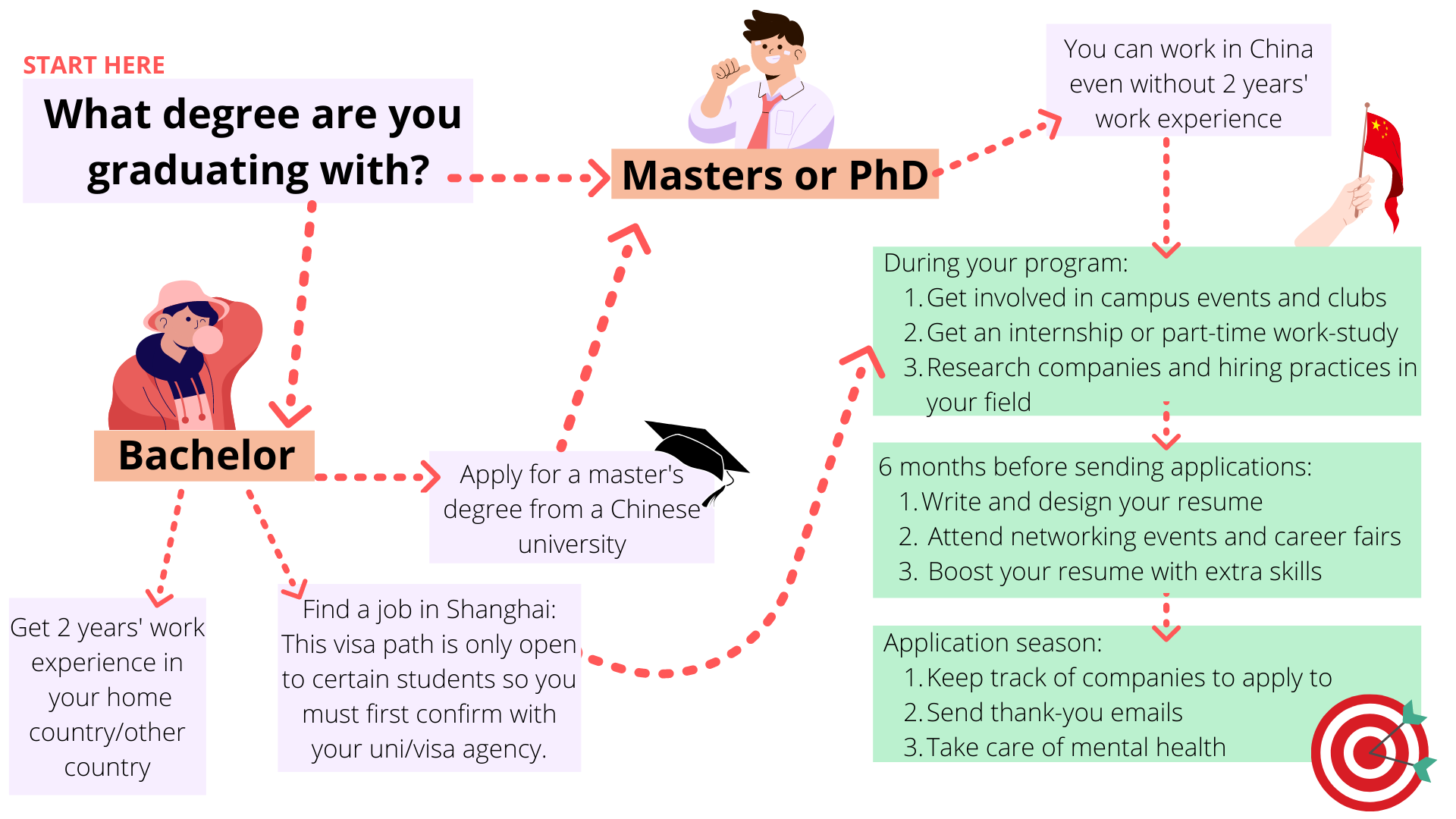
China has eased rules for study-to-work transitions. If you graduate with a Master’s degree from a Chinese university (typically “Double First-Class”) with 80%+ GPA (or equivalent), you can apply for a Z Visa (work) or R Visa (high-end talent) immediately without the standard two-year work experience requirement. This applies within one year of graduation.
Malaysia offers a Graduate Pass that lets you stay for 12 months after graduation to look for work. The pass is available to students from 32 specific nationalities. American, British, Australian, and New Zealand citizens can apply directly. Most European countries are included. Applicants from India and China need additional approvals.
Career Outcomes and Salary Growth
Chinese MBA programs show strong salary increases. Starting salaries for MBA graduates in China range from $30,000 to $70,000 depending on the role. Management consultants earn $40,000 to $70,000, financial analysts make $30,000 to $60,000, and project managers see $40,000 to $70,000. These are entry-level numbers. China’s average annual wage sits around RMB 130,000 ($17,900), but MBA roles pay significantly above this.
Malaysia’s MBA salary data shows post-graduation earnings between RM 100,000 to RM 200,000 ($23,000 to $46,000) per year. Entry-level salaries for international graduates typically start at $15,000 to $30,000 depending on industry.
China’s business schools have climbed global rankings. You can read a guide on how to find a job in China here.
Where Jobs Actually Are
China’s economy is the world’s second-largest. Shanghai, Beijing, and Shenzhen are major business hubs with offices for multinational corporations. Chinese tech giants like Alibaba, Tencent, and ByteDance have headquarters in these cities. The renewable energy sector is expanding rapidly. Finance roles pay the highest, followed by consulting and technology positions.
Malaysia’s economy is growing but smaller in scale. Kuala Lumpur is the main business center. The country serves as a regional hub for Southeast Asian operations. Tourism, education, and digital sectors offer opportunities. Companies under the Malaysia Digital Economy Corporation can hire international graduates more easily, particularly in IT roles.
Engineering and traditional sectors in Malaysia prefer local hires. Tech and digital roles are more accessible to international graduates.
Where Opportunities Are
As we advance forward with technology, the nature of the job market is changing. We are seeing a changing role of jobs, but there are always an unlimited number of opportunities and problems to solve. While most jobs are not posted, they are found from people in their network. Often it can be possible to create your own jobs, careers and opportunities with an open mind, networking and creation of content or building something that solves a problem. The core skills that you will learn on an MBA, and can learn yourself online and the people you study with, and the professors, and their industry connections, can put you in that position. I
Language Requirements
Many MBA programs in China are taught entirely in English. CEIBS, Peking University Guanghua, Renmin, Fudan, and Tsinghua all offer English-taught MBAs. You’ll need TOEFL or IELTS scores to prove English proficiency. Some programs accept the institution’s own entrance exam instead of GMAT or GRE.
Learning Chinese language helps. Daily life outside the classroom uses Chinese. HSK 5 proficiency adds points to your work permit application. Language skills open more job opportunities with local companies.
Malaysia operates in English widely, especially in business settings. Bahasa Malaysia is the official language, but you can function in English in cities like Kuala Lumpur. Knowing Malay helps with local job searches and cultural integration, but English gets you through the MBA program and most professional interactions.
Scholarships and Financial Aid
Chinese universities offer extensive scholarship programs. Around 60% of international students at Renmin Business School receive financial aid.
Scoring 750+ on the GMAT gets you 100% tuition coverage at some schools. But they don’t just look at GMAT – a high GMAT is often not necessary – they also look at your experience, drive, ambition and capability, and alignment.
The Chinese Government Scholarship (CSC) covers full tuition and accommodation. It also provides a living stipend. Beijing Municipal Government Scholarship offers full or partial tuition for one academic year. Universities also offer merit-based scholarships that don’t require separate applications.
Malaysia provides scholarships through individual universities and government programs. Public Bank and Yayasan Johor offer unbonded scholarships to Malaysian applicants at Asia School of Business. Merit-based scholarships are available but less widespread than in China.
Program Structure
Top Chinese MBA programs hold AACSB, EQUIS, or AMBA accreditation. Many partner with Western business schools. Tsinghua offers dual degrees with MIT Sloan. These partnerships give you access to exchange semesters and international networks.
Programs run 12 to 24 months. CEIBS completes in 16 months. Peking University Guanghua takes 22 months. Most programs include company visits and consulting projects. Some offer internships.
MBA programs in Malaysia also carry international accreditations from AACSB, AMBA, or EQUIS. Universiti Malaya, Taylor’s University, and Asia School of Business meet global standards. Programs typically run 1.5 to 3 years depending on full-time or part-time enrollment.
Cultural Differences and Daily Life

China operates in Chinese language. Street signs, restaurant menus, and government services use Chinese characters. You’ll need translation apps and patience. The culture values relationships and face. Business moves through networks.
Food can be cheap but is incredibly varied. It can be as simple or as extravagant as you like. Public transportation in major cities is very efficient and affordable. You can take high-speed trains between cities. Internet access requires a VPN. Sites like Google and Facebook are blocked. Western news sites won’t load without one.
On the other hand, Malaysia is much more multicultural. The Malay majority shares the country with large Chinese and Indian populations. English signage appears throughout cities. The food scene shows this mix clearly. Nasi lemak vendors operate next to dim sum shops and roti canai stalls. The climate is hot and humid year-round.
Malaysians and Chinese are both very friendly to foreigners.
In Malaysia people Islamic traditions, so alcohol is less prevalent and pork is often unavailable outside Chinese or international establishments. Living standards in Kuala Lumpur match other Southeast Asian capitals.
Application Requirements
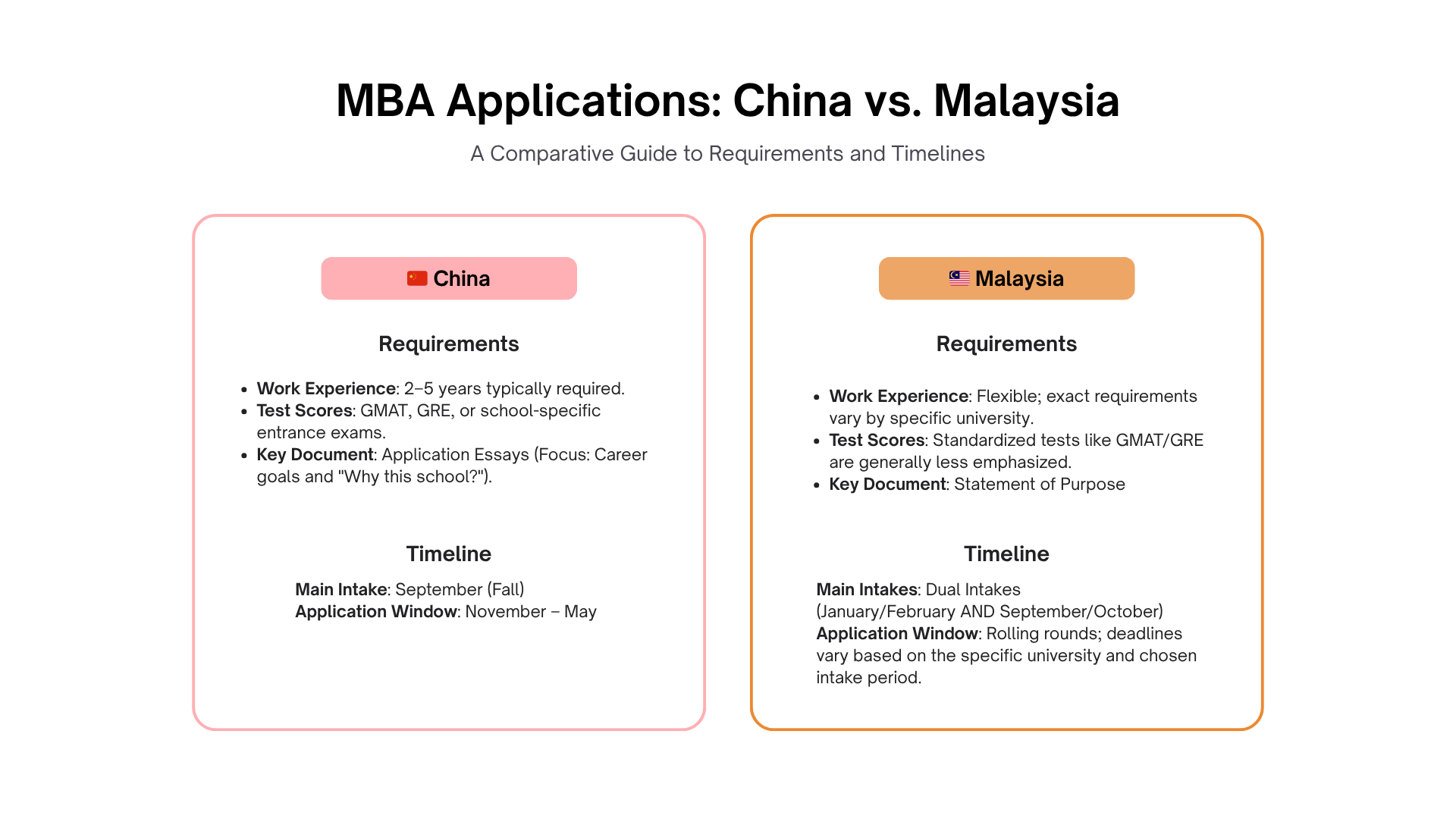
Chinese MBA programs start with the basics: a bachelor’s degree plus 2-5 years of work experience in most cases. You’ll submit GMAT or GRE scores to show academic readiness. English proficiency tests prove you can handle coursework. Programs want letters of recommendation from people who know your work. Essays give you space to explain your goals and why you picked that school. Some programs drop the work experience requirement for candidates with exceptional academic records or offer their own entrance exams instead of GMAT.
Application deadlines typically fall between November and May for fall intake starting in September. Early application improves scholarship chances.
Malaysia asks for the same core documents. You’ll submit your bachelor’s degree transcript. Work experience matters but the exact requirement depends on which school you apply to. English test scores are part of the package. Get letters of recommendation from supervisors or professors. Your statement of purpose needs to explain why you want an MBA and why that specific program fits your goals. Strong academic records can sometimes offset limited work experience.
Application rounds vary by university, with main intakes in January-February and September-October.
What Should You Choose
Study in China if you want exposure to the world’s second-largest economy. The salary growth potential is higher than Malaysia. Master’s graduates can transition to work visas more easily. You’ll have access to top-ranked Asian business schools. The tradeoff is language barriers and cultural adjustment.
Study in Malaysia if upfront cost matters most to you. You’ll pay roughly half what China charges. Daily life runs in English, so you skip the language learning curve. The multicultural environment gives you exposure to Southeast Asian business culture. Kuala Lumpur feels more relaxed than Beijing or Shanghai. The downside is a more complicated path from student visa to work permit, plus a smaller pool of local job opportunities.
Both countries offer quality MBA education at a fraction of Western costs. Your decision should match your career goals and language comfort. Think about where you see yourself working after graduation. China offers higher financial returns. The school rankings are stronger. Malaysia offers easier daily life. Upfront costs are lower.
Know what end you’re after, then choose the path that gets you there.
Continue reading:
- Full List of MBA Programs in China in English for International Students
- 10 Compelling Reasons to Study MBA in China
Browse MBA Programs in China
China is fast-becoming the go-to study abroad destination for business professionals who want to broaden their skills, develop strong leadership knowledge and advance their careers. Explore MBA programs in China and find the one that matches your career goals.
Browse MBA Programs in Malaysia
You can explore MBA programs in Malaysia on Global Admissions platform.
Frequently Asked Questions

- Studying MBA in China vs Malaysia – Which is better? - March 31, 2026
- How XJTLU Prepares Students to Lead in the AI Era - March 30, 2026
- How Beijing’s Tech Ecosystem Changes Your Business Mindset - March 29, 2026