
Over the past couple of weeks, several of our partner Chinese Universities have updated us about next year’s admissions policy. The headline: for 2026 undergraduate intake, most applicants will need to sit the new China Scholastic Competency Assessment (CSCA). This change is now moving from “rumor” to “real policy,” with official timelines and subject structure rolling out in October 2025. If China is on your shortlist, this is the update to read first.
TLDR:
China is officially launching the CSCA (China Scholastic Competency Assessment) exam for international students
Timeline: Phased in with the first exams on 21st December 2025, required for CSC scholarships for 2026, and a select group of universities, and mandatory by 2028 for all undergraduate students.
Purpose: to standardise the assessment of international students who come from different systems and countries and to raise the standards so they align with local Chinese students.
China has an ambitious “Double First Class Initiative” goal of 147 universities with “World Class Status” by 2050.
Maths will be mandatory for all students including arts / humanities – this shows the importance of maths and STEM in China.
What is the CSCA?
The CSCA (China Scholastic Competency Assessment) is a new standardized test designed for international students who want to study in China. Think of it like an academic readiness test—it’s meant to check that applicants have the skills and knowledge needed to succeed in Chinese universities.
Latest Update: Official CSCA Details (updated in October 15, 2025)
China has released more specifics about the China Scholastic Competency Assessment (CSCA) for international undergraduate admissions. The CSCA is a unified, standardized exam designed to evaluate academic readiness, especially Professional Chinese plus Mathematics, Physics, and Chemistry, so universities can compare applicants on a common scale.
Structure & Subjects
The CSCA uses a compulsory + optional model across five subjects in two groups.
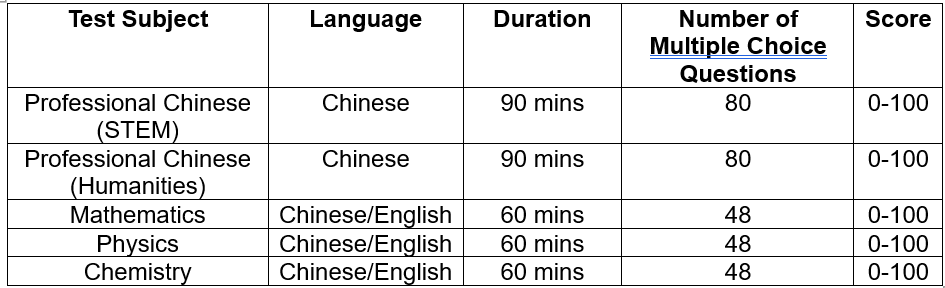
Professional Chinese
Professional Chinese is divided into two categories: Humanities Chinese and Science (STEM) Chinese. Applicants to Chinese-taught undergraduate programs must take the category that matches their chosen major. Applicants to fully English-taught programs are exempt from taking this exam subject.
Mathematics
Mathematics is compulsory for all applicants.
Physics and Chemistry
Physics and Chemistry are optional. Whether you need them depends on your target university and the specific program requirements.
Mathematics, Physics, and Chemistry are offered in both Chinese and English. Applicants may choose the test language according to the requirements of your target program.
Quick exam subject mapping (based on program):
Chinese-taught programs
- Liberal Arts & Business: Humanities Chinese + Math
- STEM: STEM Chinese + Math (+ Physics + Chemistry; could be either one or both)*
- TCSOL applicants are exempt from the Liberal Arts & Business Chinese test.
English-taught programs
- Liberal Arts & Business: Math
- STEM: Math (+ Physics + Chemistry; could be either one or both)*
*For program-specific CSCA subject requirements, always check the latest university requirements.
Test Dates
- Global inaugural test will be launched on December 21, 2025
- Starting from 2026, the exam will be held 5 times a year, scheduled for January, March, April, June, December
Test Format
- It will primarily be conducted as an online test that you can take at home; with remote proctoring.
- In selected countries, offline test centers will also be available in computer-based or paper-based formats.
Fees & Payment
- RMB 450 for one subject; RMB 700 total for two or more subjects
- Students can pay the test fees using any of the accepted payment methods (Alipay, WeChat Pay, UnionPay, VISA, MasterCard)
Exam Grading and Results
- Each subject scored out of 100
- Scores for online exam and offline computer-based tests will be released within 7 working days after the exam, while scores for paper-based tests will be released within 14 working days.
How to register for the CSCA
Where to register
All candidates register on the official CSCA website at csca.cn. This is the only place to create your account, pick subjects, choose a test window, and pay the fee.
When to register
For the inaugural sitting, registration opens in November 2025. From 2026 onward, registration windows are published ahead of each sitting across the year. Always check the portal for the latest dates.
Step by step registration process
- Create your account on csca.cn with your full name exactly as in your passport. Verify your email and complete your personal profile.
- Fill in your application basics. Choose the program language and intended major direction so the correct exam subject options appear.
- Choose your subjects. Mathematics is required for all applicants, while Physics and Chemistry are optional (depend on the major). Professional Chinese (Humanities Chinese or STEM Chinese) is required for applicants applying for Chinese-taught programs.
- Pick a test window. The first global inaugural test will be held on December 21, 2025. From 2026 there are five sittings each year (scheduled in January, March, April, June, and December). Pick a schedule that will leave enough time for score release before your earliest university deadline.
- Select the test mode. Applicants can choose to do an at-home online test. Some locations will add offline centers over time.
- Upload your photo and ID details. Follow the portal’s format and size rules. Double-check passport number, name, and date of birth.
- Pay the fee through the portal. The current fee is RMB 450 for one subject or RMB 700 total for two or more subjects. Keep your payment confirmation.
- Run the equipment check if you are testing at home. Read the proctoring instructions carefully and plan a quiet, well-lit room. Make sure you have a steady internet connection, and your equipment (including your device, microphone, and camera) are all working well.
- Attend your test. Sign in early with your passport ready for verification and follow the proctor’s guidance.
- Check your results. Online and computer-based results are typically released within seven working days; paper-based results within fourteen working days. Plan your application submission around that window.
Preparation and Tips for International Students
- Decide your program early. Choose whether you’ll apply to a Chinese-taught or English-taught program, and select your target program (major). Your choice determines which CSCA subject combination you must take.
- Start preparing early. Build the CSCA into your overall application plan. Schedule a suitable exam sitting and create a study routine that matches your target subjects.
- Get your documents ready. Prepare application materials in advance so you can submit as soon as your CSCA score is released.
- Stay updated. Keep an eye on official announcements. You can also check back on this article, which we will update periodically as universities publish more details.
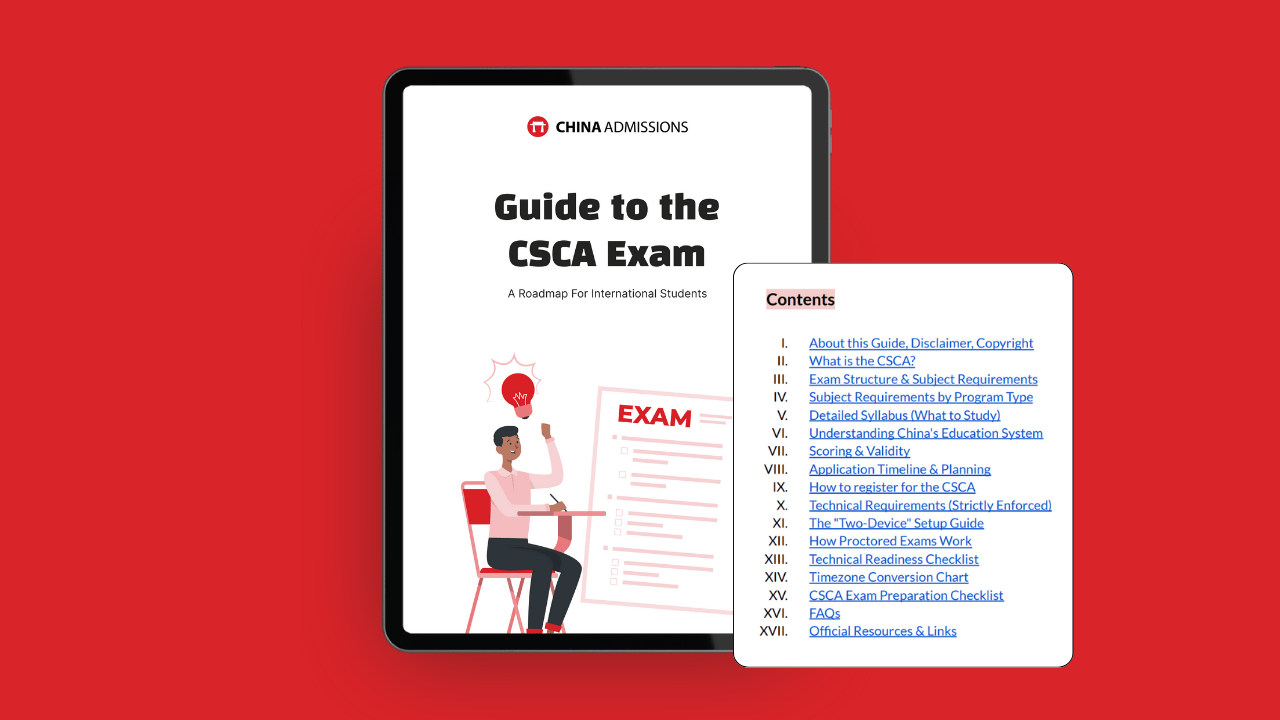
CSCA Guidebook
We have created a free CSCA guidebook to help you navigate the basics of the exam. Use this guide to clarify which subjects fit your major, understand the registration timeline, and preparation resources.
Note: This is a free educational resource, not an official document. For all official rules, updated fees, and confirmed schedules, please refer directly to the official CSCA portal at csca.cn.

Resources
Below you can find the exam syllabus sourced from the official CSCA website. They summarize the topics for each subject. Hopefully these will provide a helpful starting point for your exam study plan.
Mathematics CSCA Mathematics Examination Syllabus
Physics CSCA Physics Examination Syllabus
Chemistry CSCA Chemistry Examination Syllabus
Professional Chinese – Humanities CSCA Humanities Chinese (文科中文) Examination Syllabus
Professional Chinese – STEM CSCA STEM Chinese (理科中文) Examination Syllabus
Preparation for CSCA
Sources
This article is based on the latest information from the following official sources. You can check them for more detailed updates.
CSCA official website: csca.cn
University admissions pages and 2026 prospectuses
- South China University of Technology (2026 Admissions Guide)
- Tianjin University (2026 Admissions Guide)
- Nankai University (2026 Admissions Guide)
- Zhejiang University (2026 Admissions Guide)
Some universities have begun publishing the required CSCA exam subject combinations for their 2026 undergraduate programs. We’ve compiled a summary below, use it to confirm what your intended program expects before you register.
- Tianjin University
- Beijing Institute of Technology
- Fudan University (Chinese-taught program)
- Zhejiang University (Chinese-taught program); Zhejiang University (English-taught program)
We have also confirmed that the universities below are not yet requiring CSCA for 2026 intake:
- Tsinghua University
- Beijing Normal-Hong Kong Baptist University (BNBU)
- University of Nottingham Ningbo China (UNNC)
- Xi’an Jiaotong-Liverpool University (XJTLU)
- Sino-british College, USST
- The Chinese University of Hong Kong, Shenzhen
We will keep this page updated as new official documents are released and as universities publish their 2026 intake requirements.
Future of Admissions to Chinese Universities
Following the updated policy on the CSCA requirement, CSCA transcripts will be a required document for all international students applying to undergraduate programs starting with the 2026 intake. International applicants must first take the CSCA exam, which is offered five times a year, and obtain their official CSCA results before submitting applications to Chinese universities. This applies to applicants to public Chinese universities across China, and is especially for universities that accept students under the Chinese Government Scholarship.
With the CSCA becoming part of admissions, planning ahead matters more than ever. Choosing the right program, understanding your exam subject combination, and starting early will give you a huge advantage when applications open.

- List of Chinese Universities Application Deadlines in 2026 - March 9, 2026
- Introducing the New CSCA Exam For International Students - September 26, 2025
- What You Need to Know Before Arriving in China in 2025: Tips for International Students - August 7, 2025